Koolituse eesmärk: Osalejad saavad teadmised tööriista Tableau olemusest ning praktilised oskused erinevate interaktiivsete raportite loomiseks.
Sihtrühm ja eelteadmised: Koolitusele on oodatud kõik, kes soovivad arendada oma teadmisi ja oskusi andmete visualiseerimisel kasutades Tableau tarkvara.
Oodatud on nii juba Tableau tööriista kasutajad kui ka need, kellel puudub eelnev kasutuskogemus Tableau tarkvaraga.
Osalejal peavad olema keskmised oskused arvuti kasutamiseks, baasteadmised tabelarvutusprogrammidest (nt MS Excel) ning arusaam andmetabelite olemusest.
Õppevahendid: Windows või macOS operatsioonisüsteemiga arvuti, millel on õigused rakenduste installeerimiseks ja seadistamiseks.
Kursuse käigus kasutatakse tasuta tarkvara TableauPublicDesktop
Koolitusele saabudes peab olema õpilasel registreeritud tasuta konto ja programm arvutisse installeeritud.
Osalejal, kellel puudub vajalik õppevahend, on võimalus see BCS Koolituselt rentida. Palume sellest koolitusettevõtet eelnevalt teavitada.
Programm:
I koolituspäev Moodul 1 – Tableau ülevaade (2 ak)
Tableau Desktop, Tableau Public ülevaade
Tableau Desktop vaated:
andmeallikate vaade;
töölehe vaade;
juhtimislaua vaade;
andmeloo vaade.
Tableau Desktop’i menüüd ja kiirnupud
Mooduli lõpuks oskab osaleja orienteeruda Tableau keskkonnas ja mõistab, kuidas valida sobivaid vaateid.
Moodul 2 – Andmeallikate ühendamine ja andmete ettevalmistamine (2 ak)
CSV faili sisselugemine
Andmeallika ümbernimetamine
Andmetabeli eelvaade
Andmetulpade pealkirjad
Andmetulpade formaadid:
numbrid;
tekstid;
kuupäevad;
geograafilised näitajad.
Andmetetulpade liigid:
dimensioonid ja mõõdikud;
diskreetsed ja pidevad tunnused.
Mooduli lõpuks oskab osaleja Tableau’sse andmeid korrektselt importida ja analüüsiks ette valmistada.
Moodul 3 – Andmete visualiseerimine ja töölehtede loomine (5 ak)
Visuaalide loomine:
joondiagramm;
yulpdiagramm;
sektordiagramm;
kombineeritud diagramm;
täidetud kaart;
tabel;
risttabel.
Visuaalide vormistamine:
värvid;
suurus;
andmesildid;
detailsuse lisamine;
ülevaate lisamine (tooltip).
Filtrite lisamine
Sorteerimine
Pealkirjad
Mooduli lõpuks suudab osaleja luua ja vormistada erinevaid analüütilisi visuaale.
II koolituspäev Moodul 4 – Mitme andmeallika ühendamine (4 ak)
Andmemudeli ja tähtskeemi olemus
CSV failide sisselugemine ja ühendamine
Visuaalid, mille allikaks on mitu andmetabelit
Mooduli lõpuks saab osaleja aru andmemudeli loogikast, oskab leida õiged tulbad andmeallikate ühendamiseks ning suudab luua toimivaid tabelite vahelisi ühendusi.
Moodul 5 – Juhtimislaudade ja andmeloo loomine (5 ak)
Juhtimislaudade kujunduspõhimõtted:
visuaalide paigutamine;
pealkirjad;
värvide kasutamine.
Juhtimislauade loomine:
konteinerid;
pealkirjad;
töölehtede vaheline suhtlus;
filtrid.
Andmeloo loomine:
juhtimislaudade järjestus;
navigeerimise võimalused.
Mooduli lõpuks suudab osaleja koostada toimiva ja kasutajasõbraliku raporti.
III koolituspäev Moodul 6 – Tableau – Case Study (9 ak)
Terviklik näidisanalüüs:
äriprobleemi mõistmine;
andmete sisselugemine ja andmetabelite ühendamine;
sobivate visuaalide loomine;
visuaalide vormistamine;
juhtimislaudade loomine;
andmeloo loomine;
raporti üleslaadimine Tableau Public keskkonda;
raportite esitlemine;
raportite tagasisidestamine (peer review).
Mooduli lõpuks suudab osaleja luua iseseisvalt ühe Tableau raporti ning oskab seda esitleda.
Õppemeetodid: Õppetöös saab osaleda klassiruumi tulles või liitudes koolitusega läbi veebikeskkonna Zoom.
Koolituse maht on 27 tundi sh 22 tundi praktilisi harjutusi koolikeskkonnas.
Hindamiskriteerium: Õpiväljundite saavutamist hinnatakse koolituse ajal läbi viidud tagasisidestatud praktiliste harjutuste põhjal.
Koolituse lõpetamine: Koolituse lõpetaja saab tunnistuse, kui sooritab kõik koolituse jooksul antud praktilised harjutused.
Osalejatele, kes õpiväljundeid saavutanud ei ole, väljastatakse soovi korral tõend koolitusel osalemise kohta.
Hind sisaldab: Kohvipause koolituskeskuses ja ühiseid lõunasööke.
Õppekavarühm: 0611 Arvutikasutus.
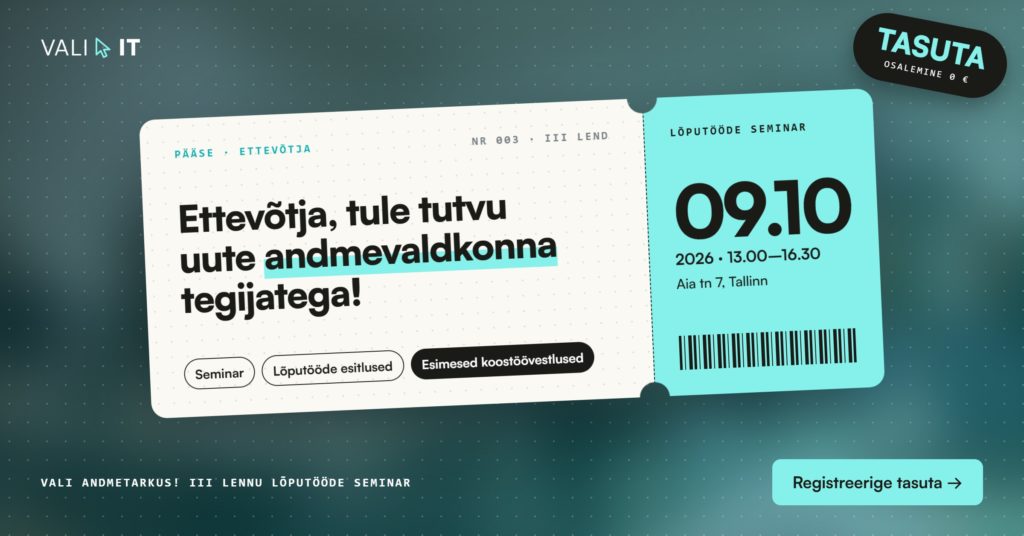
Üleskutse ettevõtetele: Vali Andmetarkus! III lennu lõputööde seminar
📊 Andmetest otsusteni: Vali Andmetarkus! III lennu lõputööde seminar
Kuidas muutuvad andmed praktilisteks otsusteks?
09.oktoobril saab seda näha Vali Andmetarkus! III lennu lõputööde seminaril, kus osalejad esitlevad oma lõputöid ja näitavad, kuidas nad on õppe jooksul omandatud andmeanalüüsi oskusi päriseluliste probleemide lahendamisel rakendanud.
Kas teie ettevõte otsib andmepraktikante, projektipõhist tuge või tulevasi andmevaldkonna töötajaid?
Lõpuseminar annab hea võimaluse tutvuda inimestega, kes on läbinud praktilise andmevaldkonna ümberõppeprogrammi ning omandanud oskused andmete kogumiseks, korrastamiseks, analüüsimiseks ja visualiseerimiseks. Programmi jooksul on osalejad töötanud tööriistadega nagu SQL, Power BI ja teised andmeanalüüsi lahendused.
Ettevõtetele on seminar hea võimalus näha, kuidas osalejad mõtlevad, milliseid tööriistu nad kasutavad ja kuidas nad suudavad andmetest luua selget sisendit otsuste tegemiseks. Lõputööde esitlused annavad praktilise ülevaate lõpetajate oskustest ning aitavad hinnata, kellega võiks jätkata koostööd praktika, projektide või võimalike tööpakkumiste kaudu.
Miks osaleda?
Saate tutvuda Vali Andmetarkus! programmi lõpetajatega, kes otsivad võimalusi rakendada oma oskusi päris tööelus.
Näete lõputööde kaudu, kuidas osalejad lahendavad reaalseid andmeprobleeme.
Saate hinnata potentsiaalseid praktikante või tulevasi töötajaid juba nende töö ja esitluse põhjal.
Saate luua esmase kontakti inimestega, kellel on huvi liikuda andmetega seotud rollidesse.
Seminaril on võimalik osaleda vaid Aia tn 7 koolituskeskuses. Täpsema info edastame registreerunud osalejatele. Soovid osaleda? Vajuta “Märgi huviliseks” nuppu ja registreeri end üritusele.
AI igapäevatöös — tehisaru praktiline koolitus oma konkurentsieelise tõstmiseks tööturul
Koolituse kuupäevad: 11,12,13,18,19,20,25,26.01 ja 15-16.02
Koolituse eesmärk: Koolituse tulemusena omandab osaleja oskused kasutada turvaliselt ja tulemuslikult generatiivseid tehisintellekti tööriistu (Microsoft 365 Copilot, Google Gemini, NotebookLM, Google AI Studio, Make.com) oma igapäevatöös. Samuti luua standardiseeritud tööprotsesse (SOP-e), AI-agente, no-code automatsioone ning teisi lihtsaid rakendusi, mis tõstavad produktiivsust ja tööturuvalmidust.
Sihtrühm ja eelteadmised: Koolitus on suunatud tööotsijatele ja töötajatele, kes soovivad tõsta oma tööturuvalmidust digiajastul. Osalemiseks on vaja arvutit, interneti kasutamise baaskasutuskogemust, oskust töötada e-kirjade, dokumentide ja veebirakendustega. Eelnevat programmeerimis- ega AI-kogemust ei eeldata. Koolitus alustab nullist, kuid liigub kiiresti edasi, nii et ka varasema kogemusega osaleja saab koolitusest kasu.
Tööandjal on võimalik taotleda töötukassa toetust töötaja koolitamiseks 80% ulatuses. Loe lähemalt siit
Õppevahendid: Osaleja kasutab oma isiklikku või korraldaja poolt pakutavat arvutit internetiühendusega. Veebiosalejatel soovituslik teine ekraan või seade paralleelseks tööks.
Koolitusettevõte tagab kõigile osalejatele koolitusperioodiks Microsoft 365 Copiloti testkontod koos litsentsidega (sisalduvad koolituse maksumuses).
Google (Gemini, NotebookLM, Google Labs, Google AI Studio) ja Make.com kontod on kättesaadavad tasuta. Koolitaja jagab kõiki harjutuste näidismaterjale (näidisdokumendid, CSV-andmestikud, koosoleku salvestused, NotebookLM-i allikad) jagatud keskkonna kaudu.
Programm: Päev 1 — AI alused, turvalisus ja promptimine (8 ak.t.)
Generatiivse AI põhimõtted (suur keelemudel, hallutsinatsioonid, piirangud);
Make.com liides ja moodulid; esimene stsenaarium (näiteks: e-kiri → Google Sheets);
integratsioonid (API, webhook, Google Sheets, e-kiri);
ruuterid, filtrid ja veahaldus;
AI-moodulite integreerimine (OpenAI, Anthropic, Google AI) — nii saab stsenaarium teha otsuseid.
Praktika: töötav AI-mooduliga stsenaarium, mis ühendab vähemalt kaks rakendust.
Päev 10 — Süntees, terviklahendus ja AI tegevusplaan (8 ak.t.)
SOP-ide lõplik viimistlemine (vähemalt 5 SOP-i osaleja kohta);
isikliku AI tegevusplaani koostamine nelja ajakihina (kohe / lähinädalad / 3–6 kuud / pikaajaline); ärikasu ja ajasäästu sõnastamine;
terviklahenduse esitlemine (rakendus, automatsioon või SOP-pakett);
pärast-koolituse plaan (ressursid, järjepidev õppimine).
Õppemeetodid: Õppetöös saab osaleda klassiruumi tulles või liitudes koolitusega läbi veebikeskkonna Zoom või Microsoft Teams. Koolitus toimub hübriidformaadis kahe samaaegse kanaliga ning sisaldab loengulist osa, demonstratsioone, individuaalseid harjutusi ja paari- ning gruppitöö vorme (kohapeal laudkondades, veebis Breakout Rooms).
Koolituse maht on 80 akadeemilist tundi (10 päeva × 8 ak.t.) sh ca 55 ak.t. praktilisi harjutusi koolituskeskkonnas. Teooria ja praktika suhe on 30–40% / 60–70%. Iga päev järgib struktuuri: 4 õppeplokki ca 2 ak.t., mis sisaldavad vahepealseid kohvi- ja lõunapause.
Hindamismeetod: Õpiväljundite saavutamist hinnatakse läbi koolituse jooksul tagasisidestatud praktiliste harjutuste (SOP-id, päringute struktureerimine, Copiloti ja Gemini analüüsiharjutused, kohandatud agendi loomine, vaibkoodimine, Make.com stsenaarium) ning lõpuprojekti koostamise ja esitlemise.
Hinnatakse kahel skaalal: õpitud oskuste tehniline rakendus ja oskuste ülekantavus reaalsesse töökonteksti.
Just see kaheosaline fookus tagab, et koolitus ei jää pelgalt tööriistade tutvustuseks, vaid annab reaalselt rakendatavad oskused.
Hindamiskriteerium: Koolitus loetakse edukalt läbituks, kui osaleja esitleb lõpuprojektina terviklahendust, mis sisaldab vähemalt viit SOP-i (standardset tööjuhist) oma tööprotsesside kohta, isiklikku AI tegevusplaani ning vähemalt üht töötavat lahendust — rakendust, automatsiooni või kohandatud AI-agenti.
Need konkreetsed väljundid tagavad, et osaleja lahkub koolituselt käegakatsutavate tulemustega, mida ta saab kohe oma töös kasutada.
Koolituse lõpetamine: Koolituse lõpetaja saab tunnistuse, kui ta osaleb vähemalt 75% koolituspäevadest (kas kohapeal või veebis) ja sooritab hindamiskriteeriumites kirjeldatud lõpuprojekti.
Osalejatele, kes õpiväljundeid saavutanud ei ole, väljastatakse soovi korral tõend koolitusel osalemise kohta.
Hind sisaldab: Hind sisaldab osalejatele vajalikke Microsoft 365 Copilot testkontosid ja tasulisi litsentse ning koolitusmaterjale.
Kohvipause koolituskeskuses ja ühist lõunat (klassis osalejad).
“Koolitus oli väga sisukas ja intensiivne. Koolitaja teadmised AI valdkonnast muljetavaldavad, kogu koolituse protsess kulges väga ladusalt ja tempokalt. Koolitaja valdas teemat, aga kõige olulisem, et ta oskas oma teadmisi jagada nii, et ka täielik AI-võhik hakkas üht-teist taipama ning ühtlasi tekitas soovi edasi õppida ja omal käel õpitud rakendada. Korralduse osas samuti maksimumhinded”
“Väga hea koolitus algajale, andis hästi palju julgust juurde”
“Tänan väga professionaalse ja hästi üles ehitatud koolituse eest. Kursus oli äärmiselt ülevaatlik ning hoidis fookust olulisel. Suurimaks väärtuseks olid elulised ja praktilised näited, mis aitasid materjali kiiresti ja loogiliselt omandada. Saadud infol on selge praktiline väärtus.”
Proxmox VE Bundle – Deployment, Management and Clustering
The objective of the course is to provide participants with the knowledge and practical skills needed to deploy, administer and troubleshoot Proxmox VE, and to design and operate a resilient multi-node cluster in a production environment.
Participants receive access to dedicated hands-on lab environments: a single-node system and a multi-node cluster.
This training is delivered by Linux Belgium, the first Proxmox Authorized Training Partner in Belgium. Linux Belgium designs and teaches the course, runs the lab environment, and issues the certification.
Training language: English
Target audience and prior knowledge (Prerequisites): The course is intended for IT professionals, system administrators, DevOps specialists and infrastructure engineers who need a complete working knowledge of Proxmox VE. Participants should have an IT background, general Linux command-line skills, and basic networking and storage knowledge. No prior Proxmox VE experience is required.
Teaching aids: A computer with Zoom, microphone and speakers, and a current version of Firefox, Chrome or Edge. Windows, macOS and Linux are supported. A second screen is recommended. Participants receive access to dedicated hands-on lab environments: a single-node system and a multi-node cluster.
Program: Part 1 – Deployment and Management (days 1 and 2)
30.11 – 01.12.2026
Proxmox VE architecture and single-server deployment considerations
Hardware and network connectivity requirements
Storage types for standalone deployments: ZFS, LVM, NFS and SMB/CIFS
Linux bridging and interface bonding
Integrated firewall functionality
Proxmox VE Software-Defined Networking (SDN)
Creating and administering virtual machines (VMs)
Linux container (LXC) deployment and management
Cloning operations and Cloud-init images
V2V and P2V migration from other hypervisors and physical systems
ESXi import tool integration
Users and permissions
Backup scheduling and retention strategies
Command-line tools, with hands-on usage
Troubleshooting methodologies
Part 2 – Clustering and Shared Storage (days 3 and 4)
3 – 4.12.2026
Cluster architecture, design considerations and quorum
Cluster deployment, node addition and removal
Cluster networking and SDN at scale
Proxmox Backup Server: deployment, retention, encryption and verification
Restore strategies and disaster recovery
Hyper-converged Ceph storage with Proxmox VE
Ceph pools, CRUSH map basics, monitoring and troubleshooting
ZFS replication for two-node and edge scenarios
High Availability (HA) groups, fencing and failover behaviour
Operational practices for HA workloads
REST API and CLI automation, and repeatable cluster operations
Cluster troubleshooting: split-brain, storage, networking and HA scenarios
Learning methods: Live instructor-led online training via Zoom, combining explanations, demonstrations, verification questions and hands-on exercises in dedicated single-node and multi-node Proxmox VE lab environments.
The total training volume is 32 academic hours.
4 days from 10:00 – 18:00 (EET)
Assessment method: Achievement of the learning outcomes is assessed through hands-on lab tasks and verification questions completed during the course, with instructor feedback.
Graduation Criteria: Participants who complete the course activities and demonstrate achievement of the learning outcomes receive the official Proxmox Course Certification issued by Linux Belgium.
Participants who do not achieve the learning outcomes may receive a certificate of participation upon request by BCS Koolitus.
The price includes:
Official Proxmox Course Certification, issued by Linux Belgium as the first Proxmox Authorized Training Partner in Belgium and Proxmox GmbH
Provided courseware
Hands-on lab access: a single-node environment and a multi-node cluster running on dedicated hardware
Verification questions after most chapters, so participants can check their own understanding as they go
Curriculum group: 0612 Database and network design and administration.
Tarkvara testimine AI ajastul ja programmeerimise alused veebirakenduste arendamiseks
Osalejad saavad esmased teoreetilised teadmised testimisest, testimise protsessist ja tehnikatest. Koolitusega kaasnevad alusteadmised programmeerimisest ja tarkvara arendusmetoodikatest, mis on soovituslikud alustamaks karjääri tarkvara testijana.
Koolitus koosneb kahest üksteist täiendavast moodulist.
Sihtrühm ja eelteadmised: Koolitusele on oodatud kõik, kes soovivad alustada karjääri tarkvara testijana ning omavad hetkel algtasemel arvutikasutusoskust.
Osaleja peab oskama hallata oma töökeskkonda ja installeerida rakendusi.
Õppevahendid: Windows operatsioonisüsteemi arvuti, millel on õigused rakenduste installeerimiseks ja seadistamiseks.
Tarkvara testija moodulis on sobiv ka MacOS operatsioonisüsteemi arvuti.
Neil, kellel puudub vajalik personaalne arvuti on võimalik seda rentida kokkuleppel BCS Koolitusega.
Programm:
Moodul 1 Programmeerimise alused veebirakenduste arendamiseks (20 ak) 02 – 04.12.2026
Mooduli kestus kaks ja pool päeva
Testimise tehnikad: must kast, valge kast, uuriv testimine
AI mõju ja tööriistad testimises, tehisaru sisaldavate rakenduste testimine
Vigade ja testitulemuste raporteerimine
Harjutused ja arutelud igas punktis
Mooduli kogumaht 20 tundi koosneb 12 tundi auditoorsest tööst (sh 4 tundi seminari ja 8 tundi praktilisi harjutusi koolikeskkonnas koos iseseisva töö esitlemisega) ning 8 tundi iseseisvast tööd, mille käigus valmib lõpuprojekt.
Õppemeetodid: Õppetöös saab osaleda klassis või läbi veebikeskkonna Zoom. Koolituse kahe mooduli kogumaht on 40 tundi sh 32 tundi auditoorset tööd (millest 9 tundi seminari ja 23 tundi praktilisi harjutusi koolituskeskkonnas) ja 8 tundi iseseisvat tööd, mille käigus valmib lõpuprojekt.
Hindamismeetod: Õpiväljundite saavutamist hinnatakse läbi Iseseiseva lõpuprojekti tegemise ja tagasisidestatud esitamise.
Koolituse lõpetamine: Koolituse lõpetaja saab tunnistuse kui sooritab kõik koolituse jooksul antud praktilised harjutused ning valmistab ette ja esitab iseseisva tagasisidestatud lõpuprojekti. Osaleja, kes lõpuprojektist loobub, saab tõendi koolitusel osalemise kohta. Lõpuprojekti valmistamine ja esitamine tõstab oluliselt osaleja võimalusi kandideerimisel tarkvara testijaks.
Hind sisaldab: Kohvipause koolituskeskuses ja ühiseid lõunasööke (poolikute päevade puhul pakutakse toekamat kohvipausi).
Õppekavarühm: 0612 Andmebaaside ja võrgu disain ning haldus.
Koolituse eesmärk: Osalejad saavad alusteadmised programmeerimisest ja tarkvara arendusmetoodikatest.
Sihtrühm ja eelteadmised: Koolitusele on oodatud kõik, kes soovivad alustada karjääri tarkvaraarenduse valdkonnas ja kellel soov ning huvi luua ise veebirakendusi.
Osaleja peab oskama hallata oma töökeskkonda ja installeerida rakendusi.
Õppevahendid: Windows operatsioonisüsteemi arvuti, millel on õigused rakenduste installeerimiseks ja seadistamiseks. Arvutil peavad olema (< >) klahvid.
Neil, kellel puudub vajalik personaalne arvuti on võimalik seda rentida kokkuleppel BCS Koolitusega.
Õppemeetodid: Õppetöös saab osaleda klassis või läbi veebikeskkonna Zoom. Koolituse maht on 20 tundi sh 15 tundi praktilisi harjutusi koolituskeskkonnas.
Hindamismeetod: Õpiväljundite saavutamist hinnatakse koolituse ajal läbi viidud tagasisidestatud praktiliste harjutuste põhjal.
Koolituse lõpetamine: Koolituse lõpetaja saab tunnistuse kui sooritab kõik koolituse jooksul antud praktilised harjutused. Osalejatele, kes õpiväljundeid saavutanud ei ole väljastatakse soovi korral tõend koolitusel osalemise kohta.
Hind sisaldab: Kohvipause koolituskeskuses ja ühiseid lõunasööke (poolikute päevade puhul pakutakse toekamat kohvipausi).
Õppekavarühm: 0613 Tarkvara ja rakenduste arendus ning analüüs.
“Koolitus oli kindlasti väga ülevaatlik ja sisukas – täpselt nii, nagu 3 päevaga saab ühte suurt teemat üldse käsitleda. Õppejõud oli oma ala proff, rahulik ja järjekindel, oskas huvi tekitada teema vastu ning kõigile küsimustele vastata nii, et ka rumal aru saaks! Õppekeskkond oli hubane ja toetav. Tulen teine kordki tagasi!”
Tarkvara testimine AI ajastul
Koolitus toimub:
07. detsember 9 – 12:15
08. detsember 9 – 12:15
14. detsember 9 – 12:15
Koolituse eesmärk: Osalejad saavad esmased teoreetilised teadmised testimisest, testimise protsessist ja tehnikatest, et alustada karjääri tarkvara testijana
Sihtrühm: Koolitusele on oodatud kõik, kes soovivad alustada karjääri tarkvara testijana ning omavad hetkel algtasemel arvutikasutusoskust.
Õppevahendid: Windows või MacOS operatsioonisüsteemi arvuti. Soovi korral võib osaleja harjutusi läbi viia ka oma personaalse arvutiga.
Testimise tehnikad: must kast, valge kast, uuriv testimine
AI mõju ja tööriistad testimises, tehisaru sisaldavate rakenduste testimine
Vigade ja testitulemuste raporteerimine
Harjutused ja arutelud igas punktis
Õppemeetodid: Kogumaht 20 tundi koosneb 12 tundi auditoorsest tööst (sh 4 tundi seminari ja 8 tundi praktilisi harjutusi koolikeskkonnas koos iseseisva töö esitlemisega) ning 8 tundi iseseisvast tööd, mille käigus valmib lõpuprojekt.
Koolitus on jagatud kolmeks 4-tunniseks päevaks, mis koosnevad kahest järjestikusest seminaripäevast koos praktilist harjutustega ning kolmandast harjutuspäevast koos iseseisva töö tagasisidestatud esitlemisega.
Hindamiskriteerium: Õpiväljundite saavutamist kontrollitakse läbi Iseseiseva lõpuprojekti tegemise ja tagasisidestatud esitamise.
Koolituse lõpetamine: Koolituse lõpetaja saab tunnistuse kui sooritab kõik koolituse jooksul antud praktilised harjutused ning valmistab ette ja esitab iseseisva tagasisidestatud lõpuprojekti. Osaleja, kes lõpuprojektist loobub, saab tõendi koolitusel osalemise kohta. Lõpuprojekti valmistamine ja esitamine tõstab oluliselt osaleja võimalusi kandideerimisel tarkvara testijaks.
Koolituse hind sisaldab: Kohvipause koolituskeskuses
Õppekavarühm: 0613 Tarkvara ja rakenduste arendus ning analüüs
Koolituse eesmärk on aidata projektijuhtimisega alustavatel ja karjääripööret tegevatel inimestel omandada olulised teadmised ja oskused, et planeerida, ellu viia ja juhtida projekte digitaalses töökeskkonnas.
Täiendavalt õpivad osalejad, kuidas kasutada tehisintellekti (AI) tänapäevases projektijuhtimises eesmärgipäraselt, tõhusalt aga samas vastutustundlikult, säilitades kontrolli otsuste, tulemuste kvaliteedi ja andmeturbe üle.
Kursuse teoreetiline osa põhineb Coursera e-õppe kursusel Google Project Management Professional Certificate, kuhu lisanduvad eksperdi poolt läbiviidavad veebiseminarid, praktilised harjutused ja reaalseid tööolukordi simuleeriv projektitöö.
Praktilise projektitöö keskkonnana kasutatakse kogu kursuse vältel projektijuhtimise tarkvara Jira.
Koolituse materjalid on ingliskeelsed, üldine suhtlus ja veebinarid toimuvad eesti keeles.
Sihtrühm ja eeldused: Koolitus on suunatud inimestele, kes soovivad alustada karjääri projektijuhina või omandada süsteemset arusaama koos vajalike oskustega edukate projektide läbiviimiseks.
Koolitus on mõeldud eelkõige:
inimestele, kes soovivad alustada karjääri projektijuhtimise valdkonnas;
spetsialistidele, kes tahavad paremini mõista, kuidas projekte struktureeritult juhitakse;
projektikoordinaatoritele, kes juba osalevad erinevates projektides (äri-, toote-, tehnoloogia- ja tugitiimides) aga soovivad tõusta ametlikku projektijuhi rolli;
kõigile, kes soovivad õppida Jirat ja tehisaru (AI) tööriistu projektitöös kasutama.
valdab inglise keelt tasemel, mis lisaks suhtlemisele võimaldab iseseisvalt aru saada õppematerjalidest, iseseisvalt õppida ja vajadusel oma mõtteid sõnastada (soovitavalt tase B1):
valmisolek 16-nädalase programmi jooksul 8 akadeemilist tundi nädalas iseseisvalt e-kursust läbida ning osaleda iganädalaselt 2 akadeemilist tundi veebiseminaril.
Eelnevad kogemused Jira või tehisaru (AI) tööriistadega ei ole nõutud, need võetakse kursuse käigus samm-sammult kasutusele.
Õppevahendid ja tehniline varustus: Osalejal läheb vaja töötava mikrofoni ja kaameraga arvutit, soovitavalt lisaekraani, stabiilset internetiühendust, võimalus installida vajalikke rakendusi ning uusim versioon Google Chrome’i brauserist.
Kui sobiv arvuti puudub, on võimalik see BCS Koolituselt laenutada – sellest tuleb koolituse korraldajat eelnevalt teavitada.
Programm: Moodul 1 – Projektijuhtimise alused
E-õpe ja iseseisev töö – u 13 akadeemilist tundi
Esimeses moodulis käsitletakse projektijuhtimise põhimõisted ja selgitatakse, milline on projektijuhi roll tehnoloogiapõhises organisatsioonis.
Käsitletavad teemad:
projektijuhi ülesanded ja vastutus tehnoloogiapõhises organisatsioonis;
projektijuhtimise elutsükli etapid toodete, teenuste ja süsteemide arenduses;
organisatsioonilise struktuuri mõju projektide läbiviimisele tehnoloogiapõhises ettevõttes;
digitaalsete tööriistade ja AI roll projektijuhtimises – kuidas neid vastutustundlikult kasutada;
tutvumine kursuse ülesehituse ja projektiülesandega.
Nädal 2 – Veebiseminar mentoriga
Projekti elutsükkel, rollid, organisatsiooni struktuur ja töötamisviisid (Agile vs. Waterfall)
(2 akadeemilist tundi)
Moodul 2 – Projekti käivitamine ja huvigruppide juhtimine
E-õpe ja iseseisev töö – u 16 akadeemilist tundi
Teine moodul õpetab, kuidas projekti käivitada – seada selged eesmärgid, kaardistada huvigrupid ja luua projektile selge ning struktureeritud plaan. Lisaks tutvustatakse Jirat, mis saab kogu kursuse vältel meeskonnatöö peamiseks töövahendiks.
Käsitletavad teemad:
projekti eesmärkide ja edukriteeriumide seadmine;
projekti lähteülesande koostamine;
projekti skoobi ja SMART-eesmärkide määratlemine;
huvigruppide kaardistamine ja analüüs äri-, toote-, tugi- ja tehnoloogiatiimides;
erinevate huvigruppide ja meeskondadega ühtse infovälja ja tõhusa kommunikatsiooni tagamine;
Jira projekti loomine ja seadistamine meeskonnatöö jaoks.
Nädal 3 – Veebiseminar mentoriga
Lähteülesande töötuba: projekti skoop, eesmärgid ja edukriteeriumid (2 akadeemilist tundi)
Nädal 5 – Veebiseminar mentoriga
Jira seadistamine: projekti ülesehitus, töövoog, rollid ja ligipääsud (2 akadeemilist tundi)
Moodul 3 – Projekti planeerimine
E-õpe ja iseseisev töö – u 9 akadeemilist tundi
Kolmandas moodulis koostatakse struktureeritud projektiplaan. Osalejad õpivad projekti tükeldama konkreetseteks tööülesanneteks ja vahe-eesmärkideks, mis lisatakse Jirasse ja mida täiendatakse terve kursuse vältel.
Käsitletavad teemad:
tööülesannete ja tulemite määratlemine;
tööülesannete hierarhilise struktuuri (THS) koostamine;
vahe-eesmärkide ja sõltuvuste määramine;
projekti tegevuste tükeldamine Jiras epicuteks ja taskideks;
ajakava koostamine ja mahuhinnangute andmine;
eelarve ja ressursside planeerimine;
riskide tuvastamine ja maandamine;
AI kasutamine planeerimise abivahendina – sõltuvuste ja riskide kaardistamine ning tulemite kriitiline hindamine.
Nädal 6 – Veebiseminar mentoriga
Tööülesannete hierarhilise struktuuri koostamine ja Jira projekti loomine
(2 akadeemilist tundi)
Moodul 4 – Projekti elluviimine, jälgimine ja lõpetamine
E-õpe ja iseseisev töö – u 30 akadeemilist tundi
Neljas moodul käsitleb projekti elluviimist tervikuna – alates ülesannete jälgimisest ja kvaliteedi tagamisest kuni huvipoolte teavitamise ja projekti korraliku lõpetamiseni.
Käsitletavad teemad:
ülesannete täitmine ja edenemise jälgimine digitaalsete tööriistadega;
projekti edenemine ja aruandlus iteratiivsetes projektides;
kvaliteedijuhtimine ja tagasiside kogumine;
koostöö erinevate osakondade vahel;
huvigruppidega kommunikatsiooni korraldamine;
AI kasutamine erinevates projektijuhtimise ülesannetes – koosolekute kokkuvõtted, projekti ülevaated, tagasiside;
Nädal 14 – Veebiseminar mentoriga
Agiilne tööde läbiviimine, meeskonna tööpraktikad ja töövoo haldamine
(2 akadeemilist tundi)
Moodul 6 – Lõpuprojekt ja esitlus
Iseseisev töö – u 42 akadeemilist tundi
Projekti loomine ja läbiviimine toimub järk-järgult kogu kursuse jooksul. Iga moodul annab uued oskused ja tööriistad: käivitamine, planeerimine, täitmine ja agiilsed tööriistad, mida rakendada oma projektitöö läbiviimiseks.
Viimases moodulis pannakse kõik kokku:
projekti tulemite koondamine terviklikuks lõpptulemiks;
projekti tulemuste ja mõju esitlemine;
kommunikatsioon huvigruppidega;
AI vastutustundlik kasutamine projekti lõpetamisel – tulemite kriitiline hindamine ja andmeturve;
projekti tulemite esitlemine selgel ja struktureeritud viisil.
Nädal 15 – Veebiseminar mentoriga
Projekti lõpetamine: projekti tulemid ja mõju, huvigruppide kommunikatsioon ja AI vastutustundlik kasutamine
(2 akadeemilist tundi)
Nädal 16 – Veebiseminar mentoriga
Projekttööde esitlused ja tagasiside. Osalejad esitlevad oma projekte ning saavad tagasisidet nii mentorilt kui teistelt meeskondadelt
(3 akadeemilist tundi)
Õppemeetodid:
Kursuse teoreetiline osa põhineb Coursera e-õppe kursusel Google Project Management Professional Certificate, kuhu lisanduvad eksperdi poolt läbiviidavad veebiseminarid ja reaalseid tööolukordi simuleeriv projektitöö.
Koolituse materjalid on inglise keeles. Veebinarid toimuvad eesti keeles.
Õppetöö toimub suhtluskanalis Slack
Korralised veebiseminarid eksperdiga toimuvad veebikeskkonnas Zoom, neljapäeviti, ükskord nädalas, korraga 2 akadeemilist tundi. Veebinarid salvestatakse hilisemaks järele vaatamiseks.
Kellaaeg 09:15–10:45
Erand: projektitööde kaitsmine koos kokkuvõttega kestab 3 akadeemilist tundi 9:15 – 11:30
Koolituse kogumaht on 157 tundi (16 õppenädalat), seal hulgas:
Õppe liik
Maht
Eksperdiga kontakttunnid
27 akadeemilist tundi
E-õpe ja iseseisev töö
130 akadeemilist tundi
Kogumaht
157 akadeemilist tundi
Õppemeetodid:
videolengud ja lugemismaterjalid Coursera platvormil;
veebinarid eksperdiga;
praktilised harjutused;
juhtumianalüüs;
digitaalne projektitöö koostamine koos esitluse ja kaitsmisega.
Õpiväljundite saavutamist hinnatakse järgmistel alustel:
Koolituse ajal läbi viidud tagasisidestatud praktilised harjutused.
Grupitööna valmiva projektitöö koostamine ja kaitsmine.
Projektitöö peab olema sooritatud lähtuvalt järgnevatest kriteeriumidest:
Projektitöö on sisuliselt ja struktureeritult kavandatud – Projektitöös on arusaadavalt määratletud projekti vajadus või probleem, eesmärk, skoop, peamised tulemid, edukriteeriumid ja huvigrupid. Projekt sisaldab peamisi projektijuhtimise dokumente või kokkuleppeid sellisel tasemel, mis võimaldab hinnata projekti loogikat, teostatavust ja seost õpiväljunditega.
Projektiplaan ja töökorraldus on rakendatud digitaalses projektijuhtimise töövahendis – Tiim on kasutanud Jirat projekti tööde struktureerimiseks ja haldamiseks. Projektitöö peab sisaldama tööde jaotust epikuteks, kasutajalugudeks ja/või ülesanneteks, vahe-eesmärke, töövoogu ning ülevaadet tööde edenemisest.
Projektitöö on esitletud ja kaitstud selgelt ning põhjendatult – Tiim esitleb projekti eesmärki, lahendust, tööprotsessi, peamisi otsuseid, riske, õppetunde ja tulemust struktureeritult. Kaitsmisel oskab meeskond põhjendada tehtud valikuid ning vastata projekti kohta esitatud küsimustele. Kui projektitöös on kasutatud tehisintellekti tööriistu, kirjeldatakse, milleks neid kasutati, kuidas tulemusi kontrolliti ning kuidas arvestati andmeturbe ja vastutustundliku kasutamise põhimõtetega.
Koolituse lõpetamine:
Koolituse lõpetaja saab tunnistuse kui koolituse õpiväljundid on saavutatud. See tähendab:
läbib kõik kohustuslikud Coursera e-õppe kursuse osad;
osaleb vähemalt 75% veebiseminaridest;
koostab, esitleb ja kaitseb rühmatööna projektitööd.
Kõik loetletud tingimused täitnud osalejad saavad tunnistuse vastavalt Eestis kehtivale täienduskoolituse standardile. Kui mõni tingimus jääb täitmata, väljastatakse osalemistõend.
Osalejatele, kes õpiväljundeid saavutanud ei ole väljastatakse soovi korral tõend koolitusel osalemise kohta.
Hind sisaldab: Ligipääsu koolituse ajal e-õppe platvormile, õppematerjalidele, suhtluskanalisse Slack ja projektitarkvarale Jira.
Õppekava rühm: 0413 Juhtimine ja haldus (IT Juhtimine)
Digital Project Management with AI Support
The aim of this training is to support the professional development of individuals entering or transitioning into project management roles by equipping them with practical skills and knowledge needed to plan, execute and deliver projects in digital work environments. Participants also learn how AI can responsibly support selected project management tasks, while keeping human judgement, output validation and data security central.
Throughout the course, participants use Jira as the main practical project management environment for their team project. The training is based on the Google Project Management Professional Certificate (Coursera), combined with practical mentor-led online webinars and a hands-on project developed throughout the course, simulating real-life project scenarios.
The course is conducted in English.
Target audience and prior knowledge (Prerequisites):
The course is intended for individuals who wish to start or transition into a project management role, particularly in digital, product, operations, business or technology-driven environments.
Suitable participants:
professionals involved in projects for example in product, operations, business or technology teams, but not yet working formally as project managers
individuals looking to change careers into project management, especially in digital or cross-functional work environments;
team members who want to better understand structured project work and how projects are managed in modern organizations.
people who want to learn how digital tools, Jira and selected AI support can be used in practical project work.
Prerequisites:
basic computer skills;
ability to work in digital environments;
English level B1–B2 (materials are in English);
willingness to commit to a structured 16-week program
prior experience with Jira or AI tools is not required. The course introduces these tools from a practical project management perspective and does not require technical AI, coding or automation skills.
Teaching aids:
Participants need a computer (Windows or macOS) with web camera and microphone; permission to install and configure applications, as well as an up-to-date web browser (Google Chrome recommended). Extra monitor during the webinars is highly suggested.
Participants who do not have the required computer can rent one by arrangement with BCS Digital Skills Academy. Please inform the training company in advance.
E-learning and independent study – approx. 13 academic hours
Participants are introduced to the fundamentals of project management and the role of a project manager in modern, digital and cross-functional work environments.
Topics include:
role and responsibilities of a project manager in digital and cross-functional teams
project lifecycle phases in digital products, service and system development;
organizational structures and how projects operate in digital and technology-driven work environments
introduction to how digital tools and AI can support the project manager’s role, while keeping human judgement and accountability central;
introduction to project work and course structure
Week 1
Webinar with the mentor
Program onboarding, course structure, tools, expectations and introduction to project work (2 academic hours)
Week 2
Webinar with the mentor
Project lifecycle, roles, organizational context and ways of working (Agile vs Waterfall) (2 academic hours)
Module 2 – Project Initiation and Stakeholder Management
E-learning and independent study – approx. 16 academic hours
Participants learn how to define a project and create a strong foundation, with a focus on digital and cross-functional project contexts. Participants also get introduced to Jira as the main practical project management environment used throughout the course for team-based project work.
Topics include:
defining project goals and success criteria for digital products, services and business initiatives;
creating a project charter;
defining scope and SMART goals in iterative environments;
identifying and analyzing stakeholders across business, product, operations and technology teams;
stakeholder communication and alignment in cross-functional settings;
introduction to project management tools used in digital project work;
setting up a project workspace in Jira;
using Jira to support team collaboration, task visibility and project work during the course.
Week 3
Webinar with the mentor – Project charter workshop: defining scope, goals, and success criteria for digital and cross-functional projects (2 academic hours)
Week 5
Webinar with the mentor
Introduction to Jira and setting up the team project workspace, including project board, basic workflow, roles, access and practical ways of working during the course (2 academic hours)
Module 3 – Project Planning
E-learning and independent study – approx. 9 academic hours
Participants develop a structured project plan and define how the project will be executed, including planning practices commonly used in digital, product and cross-functional work environments. Participants apply Jira to turn the project scope into practical work items, tasks and milestones that can be planned, tracked and updated during the course.
Topics include:
identifying project tasks and deliverables in digital, product and service-related projects;
creating a work breakdown structure;
defining milestones and dependencies in digital products, service or system development;
translating project scope into epics, tasks and milestones in Jira;
using Jira to structure practical project work and support team planning;
scheduling and timeline planning;
time estimation techniques;
budgeting and resource considerations;
risk identification and mitigation in technology-driven environments;
using AI as a support tool for selected project planning activities, such as structuring work, identifying dependencies, risks and assumptions and critically reviewing outputs against project scope, stakeholder needs and team knowledge.
Week 6
Webinar with the mentor
Breaking down project scope into WBS, tasks and milestones, and translating them into a practical Jira work structure (2 academic hours)
Week 7
Webinar with the mentor
Timeline planning, dependencies and estimation techniques (2 academic hours)
Module 4 – Project Execution, Monitoring and Closing
E-learning and independent study – approx. 30 academic hours
Participants learn how to execute, monitor and evaluate project work, including practices relevant for digital products and cross-functional project environments.
Topics include:
project execution and task tracking using digital tools;
monitoring progress and reporting in iterative environments;
quality management principles and feedback loops;
collaboration within cross-functional teams;
communication with stakeholders across business, product, operations and technology teams;
using AI support for selected project communication tasks, such as meeting summaries, status update drafts and lessons learned reflection;
project closing and documentation.
Week 9
Webinar with the mentor
Planning review: budget, risk and communication approach
(2 academic hours)
Week 10
Webinar with the mentor
Execution, quality and project closing
(2 academic hours)
Module 5 – Agile Project Management
E-learning and independent study – approx. 20 academic hours
Participants learn Agile principles and apply them in practice, with a focus on digital product development and team workflows.
Topics include:
Agile mindset and frameworks used in digital and product development;
Scrum roles and responsibilities;
product backlog creation and prioritization;
writing user stories;
using AI as a support tool to review and improve draft user stories and backlog items, while ensuring that prioritization, scope and product decisions remain owned by the team;
sprint planning and delivery cycles;
Agile delivery flow and iterative development;
team collaboration and workflow visualization (e.g. Kanban boards).
Week 12
Webinar with the mentor
User stories and product backlog workshop
(2 academic hours)
Week 13
Webinar with the mentor
Sprint planning and delivery flow
(2 academic hours)
Week 14
Webinar with the mentor
Agile execution, team practices, and workflow management
(2 academic hours)
Module 6 – Final Project and Presentation
Independent study – approx. 42 academic hours
The project is developed progressively throughout the course. Participants apply each topic (initiation, planning, execution and Agile practices) directly to their own project, ideally in a digital, product or cross-functional work context.
The final module focuses on:
consolidating project deliverables;
demonstrating project impact and outcomes;
preparing stakeholder communication;
using AI responsibly to support project work, while critically evaluating outputs and considering data security;
presenting project results in a structured way.
Week 15
Webinar with the mentor
Final preparation, project impact, stakeholder communication and responsible use of AI in project management
(2 academic hours)
Week 16
Webinar with the mentor
Project presentations and feedback. Participants present their projects and receive feedback from the mentor and peers
(3 academic hours)
Learning methods and volume of the course: The course is conducted in English.
Online webinars with the mentor are taking place Thursdays between 17:00 – 18:30 (Eastern European Time)
Webinars are recorded and shared with the participants.
You can participate in the webinars by joining through the online platform Zoom. The main communication platform for interaction with the mentor and other participants is Slack.
The course has 6 modules.
Total volume: 157 academic hours
Mentor online meetings
27 academic hours
E-learning and independent study
130 academic hours
E-learning refers to learning that takes place partially or fully using digital technological means, including video lectures, readings and guided self-study.
Participants who choose to complete additional Coursera activities and assignments related to the Google Project Management Professional Certificate may have an increased individual workload.
Methods used during the course:
E-course lectures
E-course video lectures
Workshops with a mentor
Practical exercises
Project-based learning
Evaluation method:
Completion of all mandatory Coursera e-learning courses.
Participation in at least 75% of the online webinars and workshops.
Completion and presentation of the final project.
Graduation criteria: Learners who have achieved the learning outcomes and successfully passed the assessment will be awarded a certificate in accordance with the applicable continuing education standard in Estonia.
If a participant fails to meet at least one of the following conditions, they will receive a certificate of participation instead:
not completing all mandatory Coursera e-learning courses;
not attending at least 75% of the workshops;
not completing the graduation project.
The price includes: Access to the e-learning platform and other study materials.
Curriculum group: 0413 Management and administration (IT management).
Turbetehnoloogiate rakendamine ja turvaseire ettevõttes (SC-200 Defend against cyberthreats with Microsoft’s security operations platform)
Koolituse eesmärk: Osalejad saavad teadmised kuidas Microsofti tehnoloogiate baasil kaitsta oma ettevõtte IT-taristut küberohtude eest.
Sihtrühm ja eelteadmised: Koolitusele on oodatud kõik, kes soovivad täiendada teadmisi kuidas kaitsta enda ettevõtte IT-taristut küberohtude eest ning haldavad või plaanivad hakata haldama ettevõtte IT-taristut Microsofti tehnoloogiate baasil. Sobib hästi IT administraatorile või IT spetsialistile, kes oma töös haldab hübriid- või pilvetaristut.
Õppevahendid: Microsoft M365 tenant ja Azure’i tasuta prooviversioon. Windows operatsioonisüsteemiga arvuti. Soovi korral võib osaleja kasutada oma personaalset arvutit.
Programm:
Päev 1
Turvaarhitektuuri ja turbekeskuse planeerimine:
Küberohud, ohuteadmus ja tööriistad
Zero Trust arhitektuur
SOC meeskond ja protseduurid
Sentinel baasil turvaseire metoodika
KQL päringukeel
Triaaž ja intsidentide kategoriseerimine
Päev 2
Turvaseire seadistamine ja ohujaht:
Logide kogumine üle taristu
Analüütika loomine vastavalt Mitre raamistikule
Automaatika seadistamine
Copilotforsecurity
Asitõendite kogumine ja ohtude tõrje
Päev 3
Turbetehnoloogiate rakendamine:
Ründekaitse ja turvanõrkuste seire
Microsoft Defender XDR
DefenderforCloud
Purview
Copilot ja selle võimalused
AzureOpenAI rakendamine
Koolitus põhineb Microsofti ametlikul koolituse „SC-200 Defend against cyberthreats with Microsoft’s security operations platform“ baasil ja materjalidel, aga arvestatakse kohalike Eesti ettevõtete eripärasid ja vajadusi.
Õppemeetodid:Õppetöös saab osaleda klassiruumi tulles või liitudes koolitusega läbi veebikeskkonna Teams. Koolituse maht on 27 tundi sh 15 tundi praktilisi harjutusi koolituskeskkonnas.
Hindamiskriteerium: Õpiväljundite saavutamist hinnatakse koolituse ajal läbi viidud tagasisidestatud praktiliste harjutuste põhjal.
Koolituse lõpetamine: Koolituse lõpetaja saab tunnistuse kui sooritab kõik koolituse jooksul antud praktilised harjutused. Osalejatele, kes õpiväljundeid saavutanud ei ole väljastatakse soovi korral tõend koolitusel osalemise kohta.
Hind sisaldab: Kohvipause koolituskeskuses ja ühiseid lõunasööke.
Õppekavarühm: 0612 Andmebaaside ja võrgu disain ning haldus.
Kliendi tagasiside:
“Osalesin BCS Koolituse kursusel „Küberturbe tehnoloogiate rakendamine ja turvaseire ettevõttes (SC-200 Microsoft Security Operations Analyst ametliku materjali baasil)” ning jäin koolitusega väga rahule. Koolitus oli hästi struktureeritud ning käsitles põhjalikult Microsofti turbelahendusi, sealhulgas Microsoft Defenderit, Microsoft Sentinelit ja turbeintsidentide käsitlemise protsesse. Teooria ja praktilised harjutused olid tasakaalus, mis aitas omandatud teadmisi kohe reaalses töökeskkonnas rakendada. Koolitaja valdas teemat väga hästi ning oskas keerulisi küberturbe ja turvaseirega seotud teemasid selgitada arusaadavalt ja praktiliste näidete kaudu. Eriti väärtuslikuks pidasin võimalust tutvuda reaalsete kasutusjuhtudega ning saada ülevaade kaasaegse turbetoimkonna tööprotsessidest. Koolitus andis hea ettevalmistuse SC-200 sertifikaadieksamiks ning laiendas märkimisväärselt minu teadmisi Microsofti turbeökosüsteemist. Soovitan seda koolitust kõigile IT-spetsialistidele, süsteemiadministraatoritele ja infoturbe valdkonnas tegutsejatele, kes soovivad oma oskusi turvaseire ja ohuanalüüsi valdkonnas arendada.”
Tähelepanu! Teie veebilehtiseja ei vasta kodulehe külastamiseks vajalikele nõuetele. Palun vahetage veebilehitsejat või seadet, millega te veebilehte sirvite.
Attention! Teie veebilehtiseja ei vasta kodulehe külastamiseks vajalikele nõuetele. Palun vahetage veebilehitsejat või seadet, millega te veebilehte sirvite.
Внимание! Teie veebilehtiseja ei vasta kodulehe külastamiseks vajalikele nõuetele. Palun vahetage veebilehitsejat või seadet, millega te veebilehte sirvite.